
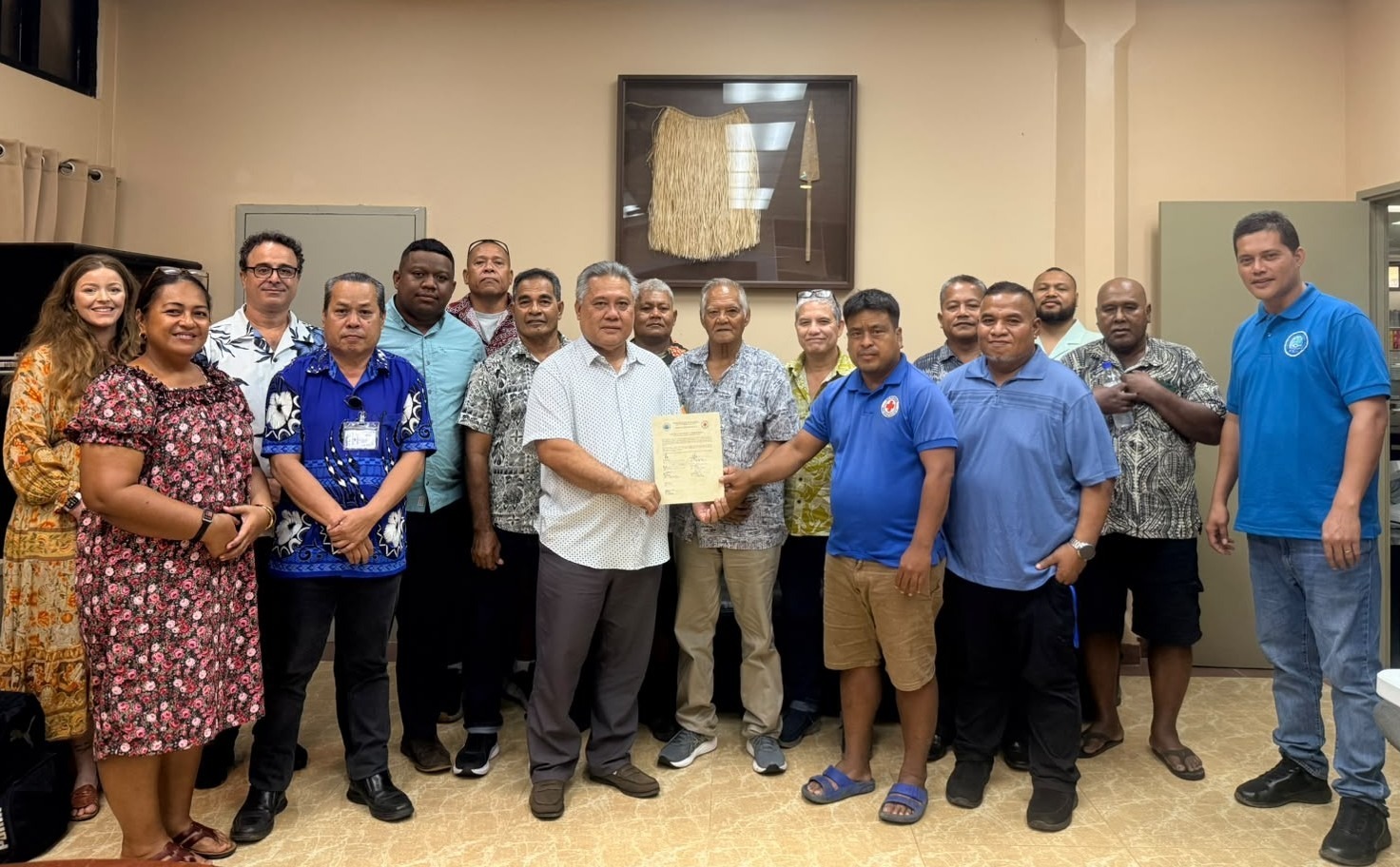
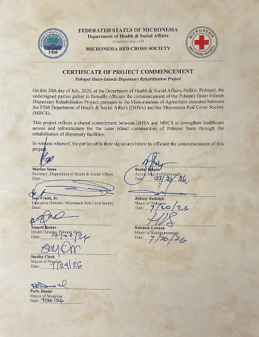
PALIKIR, POHNPEI, FSM, July 20, 2026 – After years of infrastructure gaps that left outer island dispensaries in disrepair and too often outside the reach of national investment, the FSM Department of Health and Social Affairs (DHSA) marked a turning point for outer island healthcare. DHSA hosted Pohnpei outer island community leaders, mayors and island representatives, and the Pohnpei State Department of Health Services (PDHS) to formally officiate the commencement of the Pohnpei Outer-Islands Dispensary Rehabilitation Project, in accordance with the Memorandum of Agreement executed between FSM DHSA and the Micronesia Red Cross Society (MRCS).
Outer island dispensaries have historically competed with many other pressing national priorities for limited infrastructure funding, and progress on their rehabilitation has been slow to come by. The signing represents DHSA’s deliberate move to change that trajectory, pairing with implementing partner in MRCS capable of delivering results directly to the islands that have waited longest.
Putting the Outer Islands First
For too long, dispensaries on Pohnpei’s outer islands have been left to deteriorate, with some falling into such disrepair that soon health assistants have had little choice but to see patients out of their own homes. DHSA leadership was direct in stating that the time to reverse that trend is now: without sustained investment, outer island communities risk losing the last remaining foothold of formal healthcare on their islands altogether.
Secretary Marcus Samo framed the moment as a turning point for the Department’s approach to outer island health infrastructure. “This is what health equity looks like in practice,” Secretary Samo said. “Our outer island communities have waited long enough. We are here today not just to renovate buildings, but to reaffirm that every family in Pohnpei State, no matter how remote the island, deserves a real place to receive care.” Perly Daniel of Mwoakilloa, who has pressed for the project for years, said he was “very glad” to finally see it underway.
Built With Communities, For Communities
Central to DHSA’s approach has been a deliberate insistence on community ownership from the outset. Rather than treat the dispensaries as government-managed assets, DHSA structured the project’s planning process around the community involvement from the beginning of the project. Pohnpei Chief of Public Health Semenson Ehpel, who has worked closely with the outer islands throughout the project’s development, said involving community leadership early was essential to giving communities a genuine sense of ownership, noting that health facilities ultimately rest with their communities, a deliberate signal that these dispensaries belong to the people they serve, not to the government that funds them.
That philosophy shaped the choice of implementing partner as well. After an initial competitive bid process through the FSM Department of Communication, Infrastructure and Transportation drew limited interest and a cost proposal beyond the project’s budget, DHSA turned to MRCS, drawing on the organization’s community-level experience and track record delivering similar infrastructure work for other projects in the region. Under the arrangement, MRCS will serve as the project’s implementing agent, procuring materials and coordinating construction directly with each outer island community, while DHSA provides financing and oversight, keeping decision-making close to the ground rather than routed through layers of contracting. Speaking on behalf of MRCS’s management and board, Morgan David thanked DHSA for the opportunity to support the effort, noting that stepping into service gaps and delivering for communities in a timely manner is central to the Red Cross’s auxiliary role to government.
Investing Beyond the Buildings
Secretary Samo emphasized that DHSA views the rehabilitation work as a foundation, not an endpoint. The Department intends to pair the renovated facilities with training, medical supplies and connectivity for outer island health assistants, with a longer-term vision of reliable, round-the-clock connectivity for every outer island dispensary, enabling communication with Pohnpei State hospitals and, eventually, access to telehealth and telemedicine services. He noted that DHSA is also in early discussions with a private-sector technology partner exploring US government support for digital health infrastructure across the outer islands, an effort that could build on the momentum establishment.
Secretary Samo closed by underscoring that the project’s success will be measured not just in renovated buildings, but in communities that feel ownership over their own health facilities, and expressed hope that Pohnpei’s model of community-driven, DHSA-championed rehabilitation could serve as a template for outer island dispensary improvements in FSM’s other states.
About the Project
The Pohnpei Outer-Islands Dispensary Rehabilitation Project will renovate dispensary facilities across Pohnpei State’s outer island communities, including Pingelap, Mwoakilloa, Sapwuafik, Nukuoro and Kapingamarangi, with implementation carried out by the Micronesia Red Cross Society under a Memorandum of Agreement with the FSM Department of Health and Social Affairs.
